
“Spring in Paris” may be a cliché ripe for picking, but the auction series this April genuinely felt like the proper capital of European modernism rather than a picturesque satellite of New York. The recent auctions at Sotheby’s and Christie’s did not simply deliver sprightly totals; they reasserted something more impressive, as art history rather than art hype stole the show. If the last decade has been dominated by globalised trophy hunting, the Paris sales offered a quieter but more convincing argument, one rooted in rediscovery, scholarship and connoisseurship returning to the fore.
Sotheby’s Modern & Contemporary Evening Sale on 16 April was a strong signal. The headline number, €35 million, representing an 84 per cent increase on the equivalent sale last year, was impressive enough, but the underlying composition mattered more: nearly two thirds of lots exceeded their high estimates, and two thirds were fresh to auction. These are robust numbers and a clear signal that the forthcoming NYC sales will be rampant with enthusiasm.
At the centre of proceedings were two Claude Monet paintings, fresh to market and hidden from public view. Their re emergence carried both emotional and financial heft. Vétheuil, effet du matin (1901), unseen for nearly a century, achieved €10.2 million, setting a new auction record for Monet in France, which made me think it might have made even more in the US. Painted at a moment when Monet’s ambitions were shifting decisively towards seriality and atmosphere, the work is split in two, from the colourful ambition of the top half, with a bright dawn explosion of colour, to the bottom half, which embodies texture and, dare I write, hints of pre colour-field abstraction. The ten minutes of bidding suggested collectors recognised not only rarity, but real significance.
Its companion, Les Îles de Port Villez (1883), fetched €6.5 million, comfortably above estimate. Smaller in scale, the painting belongs to Monet’s Giverny transition, when the river becomes a testing ground for movement and perception. Its value lay partly in its freshness, after 115 years in the art market wilderness, but also in how clearly it anticipates the watery obsessions that would later culminate in his vital Nymphéas (Water Lilies) series. Taken together, the two Monets accounted for a remarkable proportion of the evening total, however I felt they anchored the sale rather than overwhelming it.
Over at Christie’s, the house was full to the brim with single owner sales, from the Radical Genius collection to the wonderful Bonnards of M. Terrasse, it was a remarkable concentration of works in Christie’s gorgeous Matignon building. Perhaps my favourite work on paper in the sale series was a Paul Cézanne, which reaffirmed his importance to the art market. His depiction of Mme Cézanne was compelling, and such a signature piece in terms of structure, composition and idiosyncratic mark making, it realised a fabulous €4 million. Cézanne’s market appeal cannot solely be based on the intermittent ‘megatron’ still lifes and Mont Sainte Victoire oils of the NYC auctions, but rather on the superb, intimate innovations of his studies. His market is not cyclical but constant, and I do not know an art dealer who would not have a piece in their ‘lottery win’ collection.
Among its €40 million Evening Sale, Christie’s also saw strong results for a 1992 Richter Abstraktes Bild (€2.3 million), a huge and fabulous 1960s Poliakoff at €762,000, and a 1950s, his best period for me, Soulages for over €1.7 million. Post war continental work was a head turner this spring.
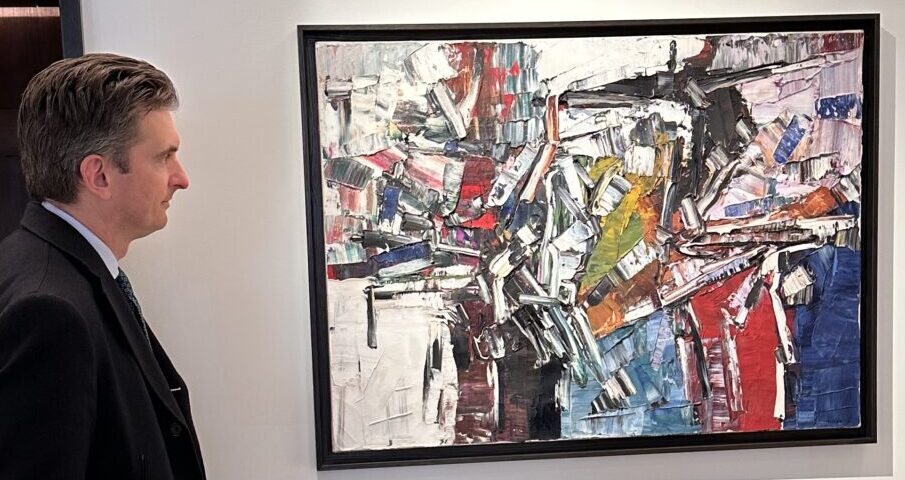
Indeed, European modernism, strong continental provenance and material that resists easy substitution, remains at the centre of the Paris market’s strength. I have long felt that post war European artists have never quite carried the same weight with international collectors as, for example, the mighty AbEx names. The connection between well funded American collectors and American art is an obvious one, but there is a growing sense that US and Asian buyers are increasingly drawn to Europe’s post war masters, the sumptuous blacks to colour oils of Soulages, the bolt like compositional force of Poliakoff at his best, and the disciplined chaos of 1940s Riopelle.
What lingers after these sales is not merely the totals, but the tone. There was little sense of froth, and less still of desperation. Instead, Paris offered something closer to balance, artworks valued for what they represent as much as for what they cost. If New York remains the theatre of the stonking masterwork, Paris has reclaimed its role as the connoisseur’s champion. For collectors attuned to that distinction, the spring auctions were very successful indeed. Remember, if you are looking to buy high value works of art, do use a trusted adviser, from both auction and trade backgrounds with a reputable trade body association such as SLAD. The pitfalls and minefields in the industry are well documented, please do not be the next statistic.