
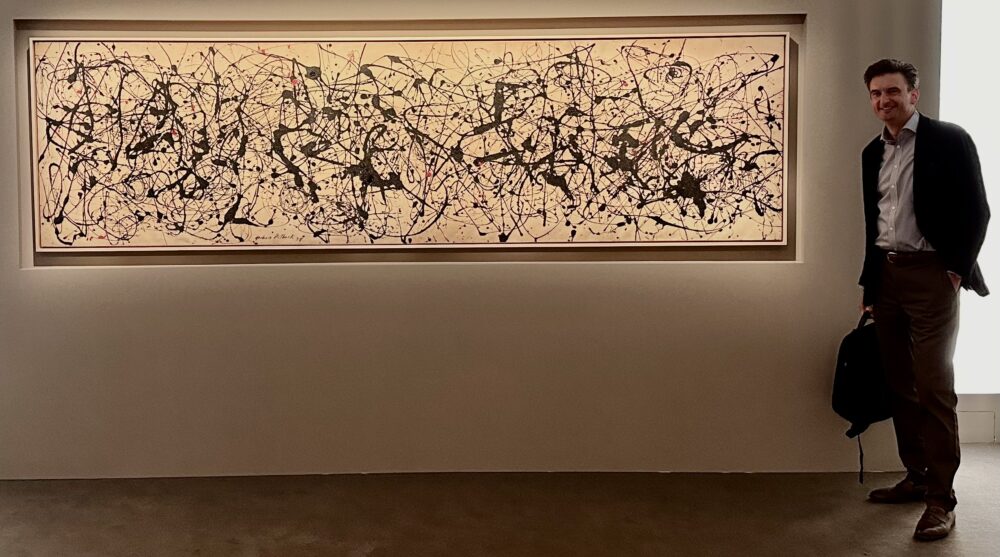
Just over 2.5 billion dollars of art changed hands during an action-packed week in Manhattan, with Sotheby’s, Christie’s, Phillips and Bonhams all playing their part in what turned out to be a momentous few days for the market. A Jackson Pollock, No. 7, selling for 180 million dollars, two Rothkos achieving prices north of 80 million dollars, and some excellent results for Minimalism ensured New York delivered in full. While the week perhaps lacked the feverish hysteria of previous cycles, the sale lists and the results themselves were undeniably strong. The market, it seems, remains remarkably untroubled by the war in Iran or a stock market that feels a little toppy by any sensible measure.
The reasons for such depth across periods and eras are not hard to identify. Tangible assets have long acted as a haven in uncertain times and art is no exception. Concerns around an overinflated US housing market, stretched tech valuations and eye watering price to earnings ratios appear to have encouraged collectors to turn paper gains into something they can actually live with. That said, this logic only holds if there is quality on offer. Over the past two years we have seen a clear cooling of appetite for the new and a decisive reversion, sometimes from a low base, to the classic art of the early and mid-twentieth century. The heat is no longer with the likes of Mark Bradford, whose works decidedly did not fly, but rather with Abstract Expressionism, Colour Field painting and the Impressionist and Modern giants such as Monet and Matisse.
The week opened strongly with Sotheby’s single owner sale from the collection of the former dealer Robert Mnuchin, which realised 166 million dollars. The headline lot was Rothko’s ‘Brown and Blacks in Reds’ of 1957, which made 86 million dollars. All the major works in the sale were pre sold with Irrevocable Bids. While the material was perhaps a little shop worn and lacked the freshness of something like the Gund collection at Christie’s, a sale of this scale was still a clear triumph for Sotheby’s, particularly when pitched against the looming Christie’s juggernaut in the form of the S I Newhouse collection. Other highlights that evening included Basquiat’s ‘Museum Security’ at 52 million dollars and Helen Frankenthaler’s ‘Cape Orange’ at 7.3 million dollars. Yet the biggest leap came courtesy of classic, easy, art-memorabilia, for that is surely what the Warhol Society portraits really are. Warhol’s portrait of Brigitte Bardot from 1974 reached 25 million dollars, firmly in Liz Taylor territory. Given that 1974 was not a peak era for Warhol, it was a useful reminder that the market is often shaped less by critique than by momentum and hype.
After a slightly fretful weekend, Monday belonged to Christie’s, whose Newhouse sale was one hundred percent pre sold and underpinned by aggressive Irrevocable Bid traffic. Later in the week came the McNeil collection, which signalled a welcome comeback for Minimalism of the 1960s and 1970s. S I Newhouse was one of the great publishing magnates of the late twentieth century and the quality of the collection reflected not just wealth but genuine taste, no doubt helped by having Larry Gagosian on speed dial. The finest works made every inch of their estimates and then some. The headline was Pollock’s ‘No. 7’ at 180 million dollars. While not the artist’s absolute peak, that honour still apparently belonging to No. 17A at around 200 million dollars in a private sale, the spectacle was immense, with three bidders active above 150 million dollars. For the right Pollock there is clearly a very high ceiling – could 1bn be possible in a few years? These paintings embody the birth of American post war art and Pollock remains, arguably, the nation’s first true fine art revolutionary. Also offered was a very rare ‘Danaïde’ of c. 1913 by the Modernist pioneer Constantin Brancusi. Selling for 108m USD it was a link between his famous series of Mme. Pogany sculptures and his later, much more abstract and minimal style. Rothko made waves again with a second major canvas from the Agnes Gund collection selling for just over 85 million dollars. That two Rothkos at this level could be absorbed in a single season was extraordinary. One suspects that had there only been one available the price might have sailed considerably higher.
The reversion to blue chip names was perhaps most evident in the twentieth century sales, where Christie’s offered a particularly charming Monet, ‘Pommiers, Vétheuil’ of 1878, which sold for 19 million dollars. It proved a real highlight for the Impressionist and Modern contingent. While my own focus has shifted increasingly towards post war art, I continue to find extraordinary value in the Impressionists of the 1870s. That bidders still pine for these perhaps rather unremarkable Vétheuil views is a joy to behold. Scarcity this season undoubtedly helped, but still, what a result.
Minimalism also found its footing again. The McNeil collection included a rare Judd ‘Stack’, which achieved 12.8 million dollars, a record for that format and only ten percent short of Judd’s overall auction high. Several top tier Dan Flavins also performed strongly. Minimalism has had a bruising couple of years, but this sale confirmed that the finest and rarest examples will always command a premium. Judd in particular has suffered from his own prolific output watering down the market, yet here the best work held steady and then some.
Works by Gerhard Richter from the estate of the late Marian Goodman sold robustly across the board. The iconic Kerze from 1982 realised 35 million dollars, squarely within estimate, while other works flew well beyond expectations. One smaller squeegee painting made over 8 million dollars against an estimate of 2 to 3 million dollars. Even allowing for the fact that these works may have circulated before, the prices demonstrated the depth of the market for this most blue chip of artists, even for paintings made as recently as the mid 1990s. Richter remains a singular figure and a genuine genius. For those priced out of the oils, his prints are well worth considering, though photo prints should be approached with care.
Sotheby’s Modern Evening Sale was another quiet success despite an oddly subdued room. Phones only really lit up for a handful of lots, yet the results were consistently strong. I was delighted to see continued momentum for Yves Tanguy, whose ‘Aux Augets le jour’ sold for 1.8 million dollars, well above estimate. Tanguy remains criminally underappreciated and I routinely urge clients to pay more attention to him than to Magritte as a Surrealist master. The commercial engine of the sale rested on two very different works. A Matisse interior, ‘La Chaise lorraine’, powered its way to 48 million dollars despite looking, at first glance, rather like a Raoul Dufy painting! The Kandinsky, ‘Rote Tiefe’ from 1925, was one of my favourites of the week. Late perhaps, but with a marvellous palette and a dancing energy that belied its date, far removed from the static compositions one often expects from that period.
One final observation concerns the mechanics of the sales themselves. The depth of bidding was impressive, with Sotheby’s day sales averaging over three bidders per lot and sell through rates north of ninety percent, closely mirrored at Christie’s. Estimates are being kept deliberately low to encourage transactions and Irrevocable Bids are now central to both day and evening sales. Guarantees are no longer the elephant in the room. In fact they have become so commonplace that buyers now quietly wonder why a work is not covered rather than why it is. Most evening sale consignors expect to be asked whether they would accept an IB, effectively removing risk before the auctioneer ever raises a hammer. Not so long ago, around 2019, a guarantee symbol was something to treat with caution. Today it is simply part of the machinery. What is striking is that the point of sale has effectively doubled, once before the auction and again in the room itself. For the very best works the seller enjoys two bites of the apple. It would not be surprising to see a future where works are pre sold and the option itself then resold. That will be an interesting moment.
I always end with the same advice, and it remains as relevant as ever. Please do use an advisor when buying high value works of art. Art collecting can be a wonderful world, but it can also be a disaster area. Clients forced to untangle poorly chosen assets years later are invariably kicking themselves for not having sought good advice earlier in their collecting journey. On that cheery note, see you at Art Basel or in June for the London sales!